
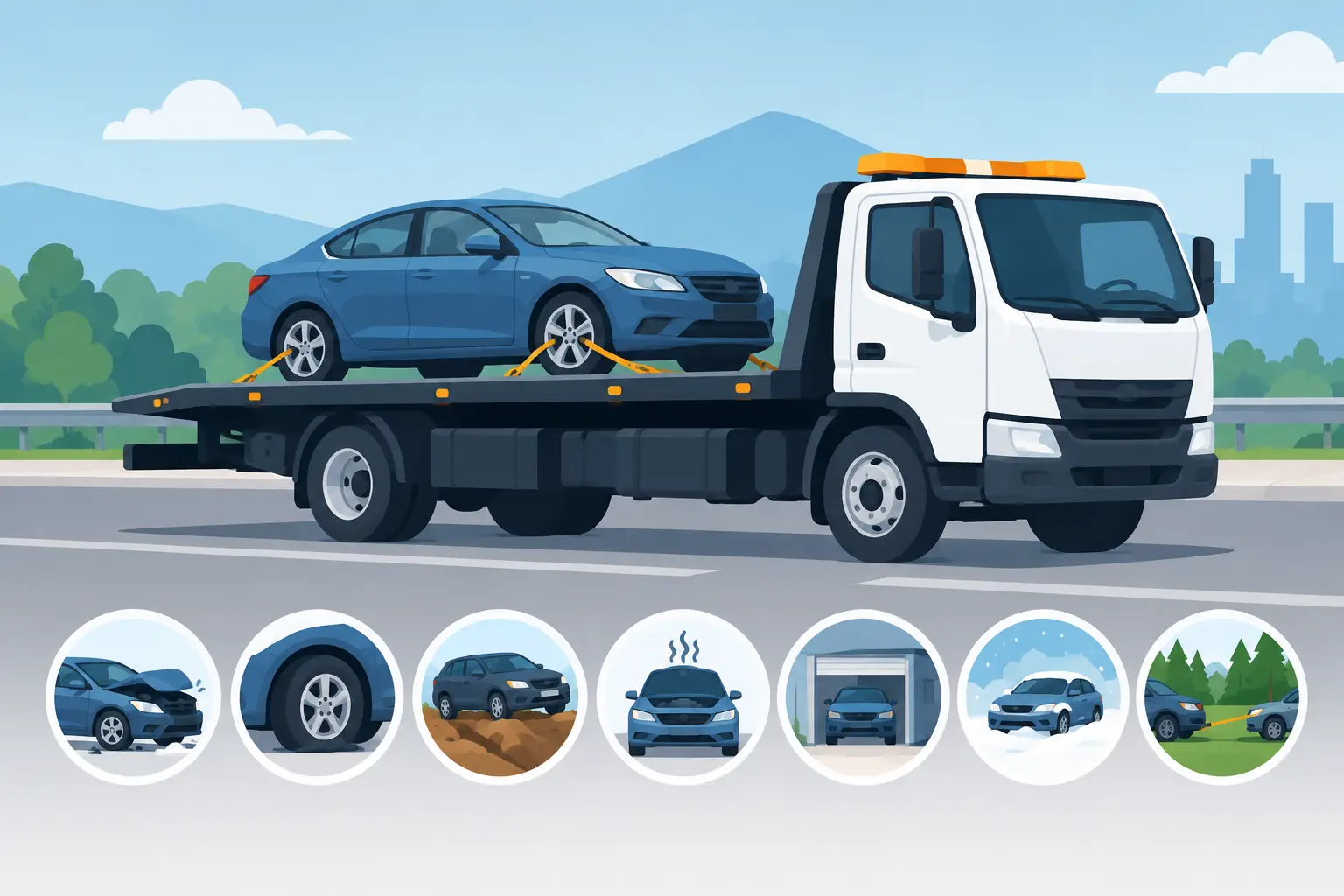
A vehicle can look drivable and still be unsafe to tow the usual way. Drivers often ask, “when should you use flatbed towing?” when a breakdown, accident, or mechanical issue leaves them unsure what will protect their car best. In many cases, placing all four wheels on a flatbed is the safest choice – especially when there is any question about damage, clearance, drivetrain type, or roadworthiness.
Flatbed towing is not just for luxury cars or severe crashes. It is a practical option for everyday vehicles across Littleton and the Denver metro area when getting the vehicle to a repair shop without adding more damage matters most.
When Should You Use Flatbed Towing?
Use flatbed towing when your vehicle cannot safely roll, should not have its wheels on the road, or needs extra protection during transport. A flatbed truck carries the entire vehicle on a level platform rather than pulling it with two wheels on the pavement.
That difference can prevent expensive drivetrain damage, avoid scraping a low bumper, and keep an already damaged vehicle stable from pickup to drop-off. The right method depends on the vehicle, what happened, where it needs to go, and the condition of the tires, suspension, steering, and transmission.
1. After an Accident
A collision can cause damage that is easy to miss at the roadside. Even if the engine starts and the car moves a few feet, a bent wheel, leaking fluid, damaged axle, loose bumper, or shifted suspension component can make driving or wheel-lift towing risky.
Flatbed towing keeps the vehicle off the ground and reduces the chance that hidden damage gets worse on the way to a body shop or mechanic. It is especially smart after front-end, rear-end, or side-impact accidents, as well as any crash that deploys airbags, damages a wheel, or leaves parts dragging near the ground.
If the vehicle is blocking traffic, safety comes first. Move away from traffic if you can do so safely, then arrange professional recovery. A towing team can assess how the vehicle sits and use the equipment that makes sense for the situation.
2. Your Car Has All-Wheel Drive or Four-Wheel Drive
Many all-wheel-drive vehicles should be transported on a flatbed. With AWD, the front and rear wheels are connected through the drivetrain. Towing only one end of the vehicle can cause internal damage because the other wheels continue turning while the vehicle is being pulled.
Some four-wheel-drive trucks and SUVs can be towed another way if the transfer case is correctly set to neutral and the manufacturer allows it. But that is not a detail to guess about on the shoulder of the road. A flatbed is generally the simpler, safer option when you do not know the vehicle’s towing requirements.
This also applies to many electric vehicles and hybrids. Their systems, low-mounted battery packs, and manufacturer instructions may call for a full flatbed rather than traditional towing.
3. The Tires, Wheels, Steering, or Suspension Are Damaged
A flat tire alone does not always require a flatbed. If the spare is usable and the vehicle is otherwise safe, a tire change may get you back on the road. But flatbed towing is the better call when you have more than a simple puncture.
Choose a flatbed if a wheel is bent, a tire is shredded, multiple tires are flat, a control arm is broken, the steering wheel will not respond normally, or the suspension has collapsed. These problems can keep the vehicle from rolling straight or sitting securely on a two-wheel tow setup.
The same goes for a vehicle with a damaged axle or wheel that is pushed inward after hitting a curb, pothole, or another car. Trying to drive it can turn a repairable issue into a larger repair. Transporting it with all four wheels secured protects both your vehicle and other drivers nearby.
4. The Vehicle Sits Low to the Ground
Sports cars, modified cars, and many luxury vehicles need extra care during loading. A low front bumper, splitter, side skirt, or lowered suspension can scrape on steep driveways, loading ramps, and uneven pavement.
Flatbed towing provides a controlled way to load and secure these vehicles. A careful operator can use the proper loading angle and attachments to reduce the risk of damage. That attention matters just as much for a well-kept daily driver as it does for a high-end vehicle.
If your car has custom wheels, performance tires, an aftermarket body kit, or very low ground clearance, mention it when you call. Clear information helps the towing operator arrive prepared with the right equipment.
Flatbed Towing for Cars That Will Not Start or Shift
A no-start condition can be caused by something minor, such as a weak battery, or something that makes driving impossible, such as an engine or electrical failure. If a jumpstart does not solve the issue, flatbed transport gets the vehicle to a repair facility without forcing it to run or roll farther than necessary.
A car that will not shift into neutral is another common reason to request a flatbed. This can happen with transmission trouble, a broken shift linkage, certain electronic shifter failures, or accident damage. Moving a vehicle that is stuck in park takes the right tools and technique. A flatbed allows the vehicle to be loaded carefully rather than dragged or handled roughly.
Transmission trouble is also a strong reason to keep the drive wheels off the pavement. If the transmission is slipping, leaking, stuck in gear, or making serious noises, stop driving. Continuing to drive can cause further damage, and towing the wrong way can add to the problem.
5. You Are Moving a Motorcycle
Motorcycles need dedicated securement, not a casual tie-down job. A flatbed can be an excellent choice for motorcycle towing because it keeps the bike upright, stable, and away from road debris during transport.
Whether the motorcycle has a dead battery, a flat tire, crash damage, or mechanical trouble, careful loading matters. The goal is to protect the forks, frame, wheels, and bodywork while getting it safely to your home, shop, or dealership.
6. The Vehicle Is a Classic, Luxury, or Specialty Car
Some vehicles deserve flatbed transport even when they are technically drivable. Classics may have older mechanical components or limited ground clearance. Luxury and performance vehicles can have sensitive drivetrains, expensive wheels, and body panels that are costly to repair. Specialty vehicles may have towing instructions that rule out conventional methods.
A flatbed does not make damage impossible, but it gives the operator more control over loading, positioning, and securement. For owners who take pride in their vehicle, that added care is usually worth it.
7. You Need to Transport a Vehicle That Is Not Registered or Road-Ready
A vehicle bought at auction, parked for months, awaiting repairs, or being moved after a private sale may not be legally or mechanically ready for the road. Flatbed towing is a practical way to move it without risking a breakdown, citation, or unsafe drive.
This is also useful when moving a junk vehicle, a project car, or a vehicle with expired registration. Instead of trying to make one uncertain trip, arrange transport directly to the destination.
Flatbed vs. Wheel-Lift Towing: Which Is Better?
Neither method is automatically better for every vehicle. Wheel-lift towing can be efficient for certain local tows when the vehicle is intact, the drivetrain allows it, and the wheels that remain on the ground are safe to roll. It can also be useful in tight parking areas where positioning a flatbed is difficult.
Flatbed towing is usually the better choice when there is damage, drivetrain uncertainty, low clearance, multiple flat tires, or a vehicle that cannot roll normally. It may take more room to load and can cost more in some situations, but avoiding preventable damage is often the more affordable outcome.
When you call for help, share what you know: the vehicle’s year, make, and model; whether it is AWD, four-wheel drive, electric, or lowered; the type of damage; and where it is parked. You do not need to diagnose the problem perfectly. Those details simply help dispatch send the safest towing option.
A breakdown is stressful enough without having to make a technical towing decision alone. If you are in Littleton, Highlands Ranch, Centennial, Castle Pines, Denver, or Lakewood, Ortiz Towing can help determine whether a flatbed is the right fit and transport your vehicle with care. When something feels unsafe, do not force the drive – get the vehicle secured and let a qualified professional take it from there.